Parkinson's disease develops when nerve cells involved in movement become damaged, especially dopamine-producing neurons in the substantia nigra.
Rest tremor
Parkinson's disease is a progressive nervous-system disorder that affects movement and can also cause non-movement symptoms.
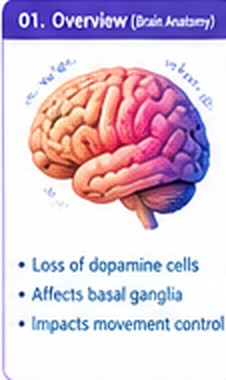
Parkinson's disease develops when nerve cells involved in movement become damaged, especially dopamine-producing neurons in the substantia nigra.
Loss or dysfunction of dopamine-producing neurons disrupts brain circuits that coordinate smooth purposeful movement.
Parkinson disease is distinct from atypical parkinsonian disorders such as multiple system atrophy, progressive supranuclear palsy and corticobasal degeneration.
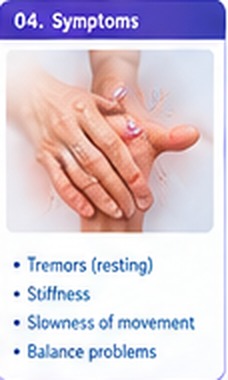
Rest tremor
Bradykinesia
Rigidity
Balance or gait problems
Constipation or sleep problems
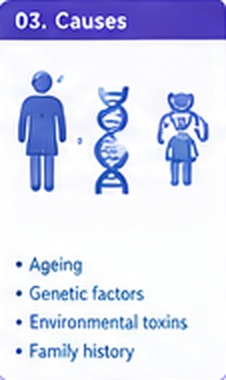
The exact cause is usually unknown. Genetic susceptibility and environmental factors may contribute; some cases are inherited.
Older age
Family history
Certain genetic variants
Some environmental exposures
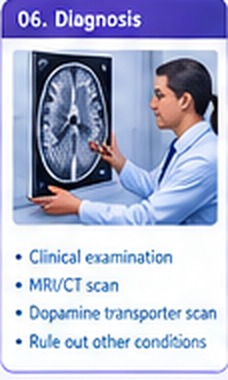
History and neurological examination; laboratory and imaging tests may be used to exclude other disorders. DaT imaging can support selected evaluations but is not definitive alone.
Neurological examination
Gait and balance assessment
Medication review
Blood tests to exclude other causes when indicated
MRI brain when another disorder is suspected
DaT scan in selected cases
Specialist movement-disorder assessment
Selected genetic testing in appropriate families
Essential tremor
Drug-induced parkinsonism
Multiple system atrophy
Progressive supranuclear palsy
Clinical severity may be described with scales such as Hoehn and Yahr; progression varies substantially between people.
Staging or grading systems differ between diseases. The information here is educational and should be interpreted by a qualified healthcare professional in the context of the individual case.
Carbidopa-levodopa and other medicines, physical/occupational/speech therapy, exercise and selected surgical treatments can reduce symptoms.
Carbidopa-levodopa
Dopamine agonists
MAO-B inhibitors
COMT inhibitors
Amantadine for selected symptoms
Medicines listed here are for educational information only. Do not start, stop, or change a medicine without professional medical advice.
Falls, swallowing problems, medication fluctuations, dyskinesia, sleep problems, cognitive changes and autonomic symptoms can occur.
Sudden severe confusion or weakness
Repeated falls with serious injury
Choking or inability to swallow safely
If symptoms are severe, rapidly worsening, or life-threatening, seek emergency medical care immediately.

Progression varies. Treatment aims to preserve mobility, independence, communication and quality of life.
Survival statistics describe outcomes in groups of people and cannot predict exactly what will happen to one individual. Prognosis depends on factors such as cancer stage, tumor biology, treatment response, overall health, and follow-up.
Parkinson disease is more common with increasing age but can occur earlier. Family history explains a subset of cases.
No established prevention strategy exists for most cases; maintaining physical activity and general health is reasonable.
Could my symptoms be Parkinson disease?
Which medicines are appropriate for my symptoms?
Would physiotherapy or speech therapy help?
BimariDur provides educational health information to help people understand diseases, symptoms, tests, and treatment concepts. It does not replace examination, diagnosis, or treatment by a qualified healthcare professional.
Do not delay professional medical care because of information read on BimariDur.