Mammary ducts and lobules, surrounded by connective tissue.
Painless lump in the breast, changes in breast shape, or skin dimpling.
Malignant epithelial transformation of mammary ducts, representing the most prevalent female cancer in India.
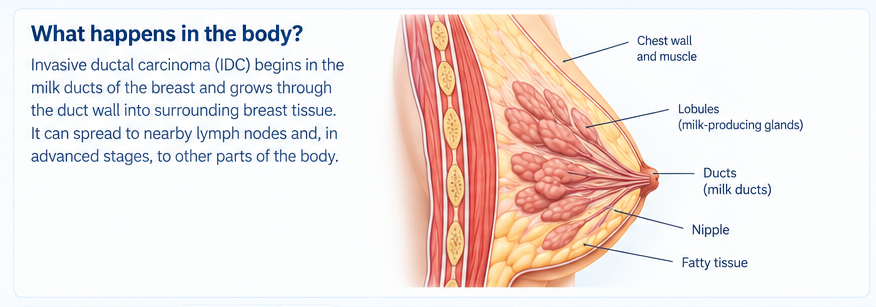
Mammary ducts and lobules, surrounded by connective tissue.
Breast carcinogenesis originates via monoclonal expansion from a single epithelial cell that has accumulated sequential genetic and epigenetic alterations. Mutations in tumor suppressor genes (such as BRCA1, BRCA2, and TP53) or amplification of proto-oncogenes (such as ERBB2/HER2) disrupt cell cycle checkpoints, leading to uncontrolled proliferation. This typically initiates within the terminal duct lobular units (TDLUs) as atypical ductal hyperplasia, progressing to ductal carcinoma in situ (DCIS) before breaching the basement membrane to become invasive carcinoma.
Malignant transformation begins in the epithelial cells of the milk ducts.
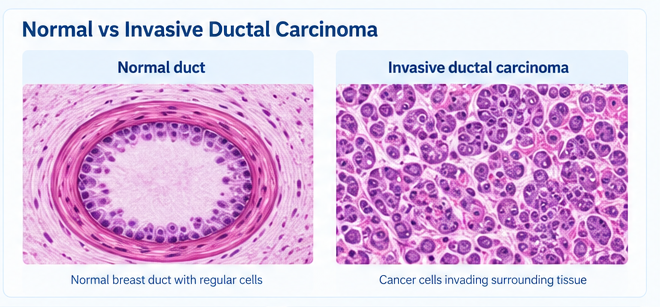
Invasive Ductal Carcinoma (IDC), classified under ICD-11 2C61.
Invasive Ductal Carcinoma (IDC) accounts for 70-80% of cases, characterized by hard, fibrous nests of malignant cells. Invasive Lobular Carcinoma (ILC) accounts for 10-15%, growing in single-file patterns with a lower incidence of palpable lumps. Special subtypes include Triple-Negative Breast Cancer (TNBC, highly aggressive, lacking ER, PR, and HER2 receptors), Hormone Receptor-Positive (ER+/PR+, responsive to endocrine therapy), HER2-positive (driven by HER2 gene amplification), and rare entities like Inflammatory Breast Cancer and Medullary Carcinoma.
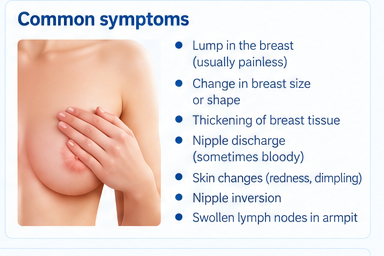
Painless lump in the breast, changes in breast shape, or skin dimpling.
Painless lump in the breast, changes in breast shape, or skin dimpling.
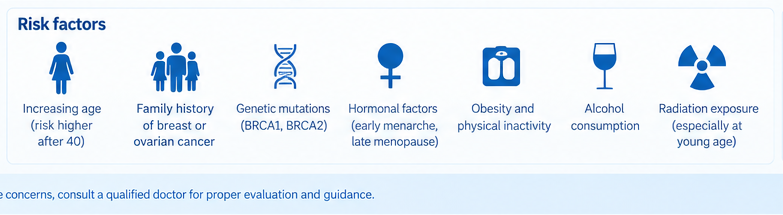
Key risk factors include inherited germline mutations in BRCA1 and BRCA2 genes (conferring up to a 72% lifetime risk), family history in a first-degree relative, prolonged endogenous estrogen exposure (early menarche before age 12, late menopause after age 55), nulliparity, late age at first full-term pregnancy, exogenous hormone replacement therapy, ionizing radiation exposure to the chest wall, dense breast tissue, and lifestyle factors such as alcohol consumption, obesity post-menopause, and physical inactivity.
Family history of breast cancer, genetic mutations, and hormonal exposure.
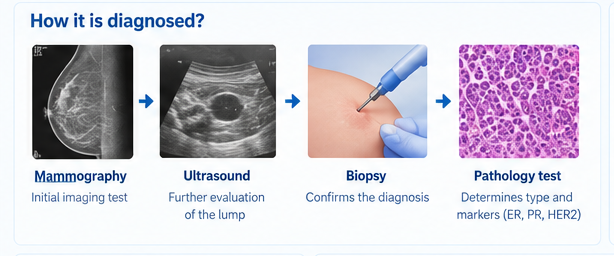
Comprehensive diagnostic workup integrates bilateral diagnostic digital mammography with breast tomosynthesis, high-resolution targeted ultrasonography for dense tissue differentiation, and dynamic contrast-enhanced magnetic resonance imaging (MRI) for multi-focal disease mapping. Definitive diagnosis requires image-guided core needle biopsy or vacuum-assisted stereotactic biopsy, followed by histopathological grading (Nottingham Score) and immunohistochemical (IHC) profiling for Estrogen Receptor (ER), Progesterone Receptor (PR), HER2/neu overexpression, and Ki-67 proliferation index.
Mammography, core needle biopsy, and hormone receptor status testing.
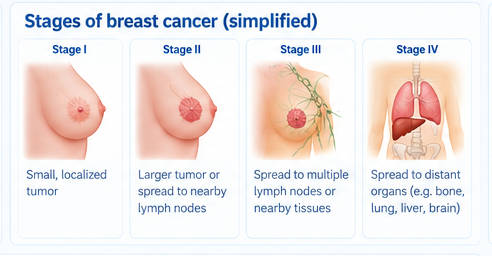
Utilizes the AJCC TNM (Tumor, Node, Metastasis) staging system: Stage 0 represents non-invasive carcinoma in situ (DCIS). Stages I through III represent localized and regional disease defined by tumor size, chest wall invasion, and extent of axillary or internal mammary lymph node involvement. Stage IV represents metastatic disease defined by distant organ spread, most commonly to bones, lungs, liver, and brain.
Staging or grading systems differ between diseases. The information here is educational and should be interpreted by a qualified healthcare professional in the context of the individual case.
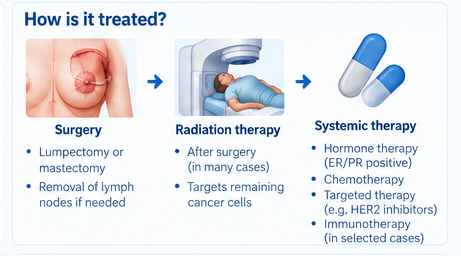
Multidisciplinary management involves surgical intervention via breast-conserving surgery (lumpectomy with clear margins) or total mastectomy, combined with sentinel lymph node biopsy or axillary lymph node dissection. Adjuvant or neoadjuvant systemic therapy includes chemotherapy regimens (anthracyclines and taxanes), targeted monoclonal antibodies (trastuzumab and pertuzumab for HER2+), antibody-drug conjugates (such as T-DXd), endocrine therapy (tamoxifen for premenopausal women, aromatase inhibitors for postmenopausal women), and whole-breast or chest wall radiation therapy to reduce local recurrence.
Tamoxifen, aromatase inhibitors, and targeted monoclonal antibody therapies.
Tamoxifen, aromatase inhibitors, and targeted monoclonal antibody therapies.
Medicines listed here are for educational information only. Do not start, stop, or change a medicine without professional medical advice.
Short- and long-term medical complications include chronic lymphedema of the upper extremity, post-mastectomy pain syndrome, surgical site seromas or infections, chemotherapy-induced peripheral neuropathy, premature ovarian failure, cardiotoxicity from HER2-targeted agents, and psychological morbidities such as anxiety and depressive disorders.

Five-year relative survival rates vary significantly by stage at diagnosis: approximately 99% for localized disease, 86% for regional spread, and 30% for distant metastasis. Key prognostic indicators include histological grade, tumor size, lymph node status, and molecular subtype (ER/PR/HER2 status).
Survival statistics describe outcomes in groups of people and cannot predict exactly what will happen to one individual. Prognosis depends on factors such as cancer stage, tumor biology, treatment response, overall health, and follow-up.
Breast cancer is the most frequently diagnosed malignancy worldwide among women, accounting for over 2.3 million new cases annually. While high-income regions exhibit higher baseline incidence rates due to screening availability, low- and middle-income regions face disproportionately higher mortality rates driven by late-stage diagnosis.
Primary prevention involves lifestyle modifications such as maintaining a healthy body weight, regular aerobic physical activity, limiting alcohol consumption, and avoiding prolonged postmenopausal hormone therapy. Secondary prevention centers on regular annual screening mammography, clinical examinations, and prophylactic risk-reducing options for high-risk BRCA mutation carriers.
BimariDur provides educational health information to help people understand diseases, symptoms, tests, and treatment concepts. It does not replace examination, diagnosis, or treatment by a qualified healthcare professional.
Do not delay professional medical care because of information read on BimariDur.